In today’s dynamic fuels and convenience industry, enterprises manage complex ecosystems of applications, data, and processes. With many organizations relying on dozens of different systems, coordinating workflows, ensuring data accuracy, and maintaining operational efficiency pose significant challenges. AI empowers us to tackle these complexities with a new form of automation, commonly called agentic automation. This approach combines intelligent agents, robust data management, and orchestrated workflows to address industry complexities that have stymied our best efforts over many different waves of technology.
Last week, Vlad Collak and I, had the pleasure of presenting on this topic with a session entitled, “From Data to Doing – Practical AI for the Fuels and Convenience Industry” at US Bank’s Voyager Channel Partner Roundtable. We covered very practical AI applications for fuel marketers, distributors, cardlock operators and fleet card issuers that can drive ROI immediately and extend the investments already made in the systems, software and technology in use by these companies today.
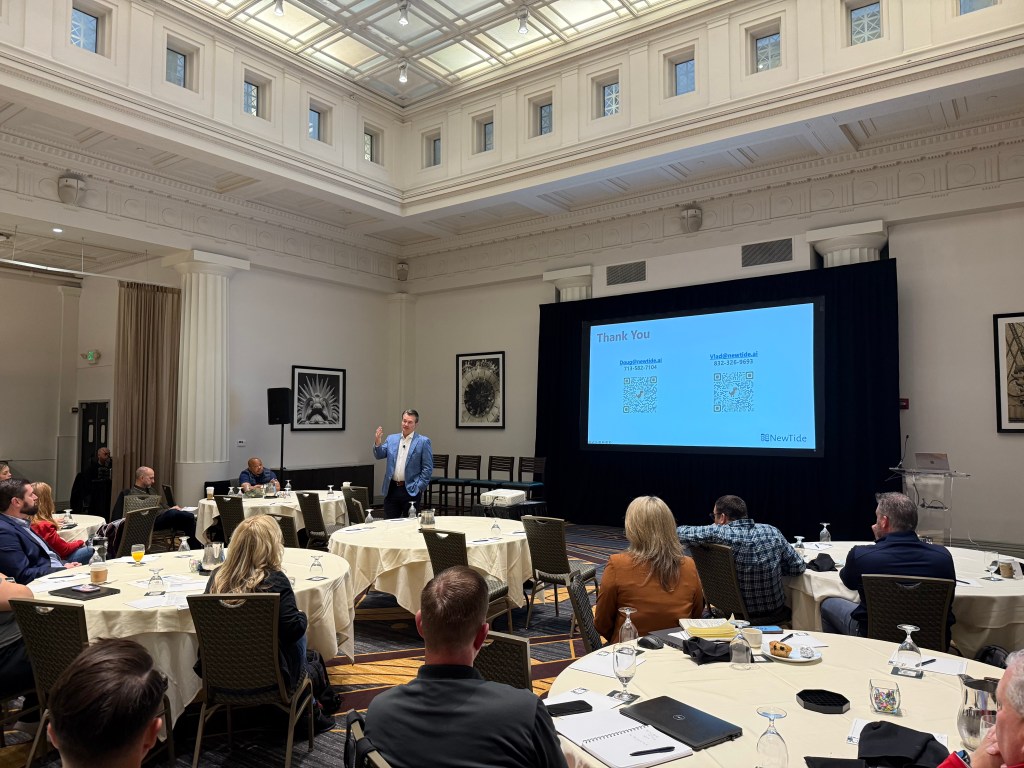
Before jumping into the topic too far we covered a lot of AI fundamentals and discussed how to form a simple mental model about how to think about using AI and where to apply it. We started with a discussion on data and how critical it is that you keep control of your data and how it is used and internalized by AI.
In many ways your data is a representation of your company. How you uniquely operate to compete, to win and to make money. Defining early on how you can harness your data to be useful to AI’s while also keeping control and ownership of your data is crucial to securely deploying any AI platform.
While it maybe perfectly reasonable for AI to learn from your data if it’s buried in your accounting system and doing something very common like trying to apply cash receipts, once you progress to using your data in strategic ways to engage customers, optimize pricing, or to understand and apply contracts you need to keep the innovation, training and new capabilities within your company.
We also talked a lot about our organizational charts and our people, for two important reasons. First if you don’t have a clear message for your team on how and why you are going to leverage AI they will assume you are doing it to get rid of them. Unfair assumption? Sure, but nonetheless, clear and frequent messaging across your company on the how’s and why’s about AI is essential to success. A focus on clear objectives that empower your employees to have better jobs, perform less mundane tasks, and enjoy higher productivity is critical, say so early and often.
The second reason we spent a good amount of time on the org chart is because we believe one of the easiest ways to think about where and how to apply AI to your business is to start with your people and team. Deploying AI is more like hiring and onboarding new employees than it is a specific rigid technology platform or improvement. This technology truly introduces intelligence to the equation in a way that hasn’t been possible before. Leveraging this new capability can impact every role, job, function and specialty you have on your org chart today. Just to start, every employee can enjoy the luxury of having an assistant, EA’s aren’t just for the C-Suite anymore.
Beyond just having an assistant, your team can now build fully trained and capable agents, that they can now empower to do work for them, not just help them do more work. This is a crucial difference to previous waves of technology that made us all more productive, but didn’t multiply us.
Beyond the focus on data and people, we focused on the ability to use this new intelligence to move from data to doing. How to actually build and onboard your own agents like you would new employees. How you then connect those new digital employees with real work and live processes to start getting that work done.
In the rest of this article we’ll attempt to capture the main elements of that part of the presentation as well as address some of the questions and ideas that circulated at the event.
But first, maybe best to start with some definitions of the terms and naming conventions we use to discuss this new technology.
Core Definitions
Agentic AI
Agentic AI refers to intelligent agents, for us they reside within the Rising Tide platform, that leverage advanced cognitive capabilities—such as learning, reasoning, and decision-making—to autonomously handle complex tasks. These agents, built and trained in what we call Agent Harbor, adapt to evolving data patterns and business needs, enhancing automation outcomes.
Agentic Automation
Agentic automation is becoming widely recognized as the AI based approach to intelligent enterprise automation. For us this integrates Data Helm’s data processing with our Agent Harbor AI agents, and the Shipyard factory’s workflow orchestration to create a synergistic ecosystem. This enables seamless collaboration between humans, systems, and AI agents, optimizing processes. For our industry that might range from Customer Set Up to Credit Line Underwriting to BOL collection or fleet card processing on through to automated Invoicing, driving both efficiency and accuracy.
Agentic Orchestration
Agentic orchestration, powered by Shipyard, acts as the backbone of NewTide AI’s automation strategy. It coordinates workflows by assigning tasks to the most suitable entity—simple agents for repetitive actions, advanced agents for decision-making, and humans for strategic oversight—ensuring alignment with business goals.
Why Agentic Automation?
Traditional Robotic Process Automation (RPA) can excel at rule-based tasks but struggles with unstructured data and adaptive decision-making. For example, processing BOLs involves extracting data from emails, analyzing unstructured attachments, and integrating with downstream systems like PDI or RightAngle—a task beyond RPA’s capabilities.
Agentic automation addresses these challenges by:
- Handling Unstructured Data: Data Helm ingests and transforms raw data from emails or documents into structured, AI-readable formats.
- Enabling Contextual Decisions: Agent Harbor’s AI agents analyze data, make informed decisions, and adapt to real-time changes.
- Orchestrating Complex Workflows: Shipyard builds end-to-end workflows, ensuring seamless task handoffs and system integrations.
This approach empowers enterprises to automate intricate processes, reduce errors, and enhance operational agility.
The Agentic Approach
Agents think. Data flows. Workflows deliver. Humans lead.
The Rising Tide platform redefines automation by integrating three core components:
1. Data Helm
Data Helm is the foundation for data ingestion and management. It captures raw data from diverse sources (e.g., emails, documents), stores it in a scalable Data Lake, and transforms it into structured formats for AI processing. For BOL automation, Data Helm extracts data from email attachments, vectorizes it, and prepares it for downstream analysis.

2. Agent Harbor
Agent Harbor enables the creation, training, and deployment of AI agents. These agents perform tasks like data analysis, classification, and decision-making. In the BOL use case, agents analyze extracted data, assess creditworthiness, and generate outputs, continuously learning to improve accuracy.

3. Shipyard
Shipyard is the workflow factory that orchestrates automation. It integrates Data Helm’s data, Agent Harbor’s agents, and external systems into cohesive workflows. Shipyard’s drag-and-drop editor and support for 300+ services enable rapid workflow design, as seen in the BOL automation process.

4. Humans
Humans provide strategic oversight, governance, and creativity. They validate AI decisions, handle exceptions, and ensure alignment with business objectives, maintaining trust and compliance.
This ecosystem ensures that repetitive tasks are automated, complex decisions are informed by AI, and humans focus on high-value activities.
The Business Value
Agentic automation delivers measurable benefits:
- Operational Efficiency: Automates end-to-end processes like BOL workflows, Trade Capture and Confirms, or Delivery Ticket Matching and Reconciliation, reducing processing time and manual effort.
- Accuracy and Consistency: Minimizes errors in data extraction and processing, ensuring reliable outputs.
- Scalability: Supports dynamic workloads and integrates with existing systems to extend your investment in your existing systems, not to rip and replace them.
- Enhanced Stakeholder Experience: Faster, more accurate processes improve customer and employee satisfaction.
- Cost Savings: Reduces operational costs by automating manual tasks and optimizing resource allocation.
- Governance and Trust: Ensures secure data handling and compliance through robust platform services.
- Workforce Empowerment: Frees employees from repetitive tasks, enabling focus on strategic initiatives.
The Backbone: Orchestration with Shipyard
Shipyard is the nerve center of NewTide AI’s agentic automation, orchestrating workflows to maximize efficiency. It:
- Assigns rule-based tasks to AI agents, decision-making tasks to AI managers, and strategic roles to your people.
- Integrates with 300+ services, including email, databases, and cloud storage.
- Supports complex logic with conditionals, loops, and branching, enabling adaptive workflows.
- Provides transparency and centralized control, aligning automation with business goals.
The Foundation: Secure Integration and Governance
Security and governance are critical to agentic automation. The Rising Tide platform ensures:
- Secure Data Handling: Data Helm employs encryption, access controls, and vulnerability management to protect sensitive data.
- Compliance: Platform services like Key Vault and Observability ensure adherence to industry standards.
- Integration: Supports API management and role-based access, enabling seamless connections with existing enterprise systems.
- Auditability: Provides comprehensive monitoring and audit trails for transparency.
An Example: BOL Automation Workflow
The BOL automation workflow illustrates NewTide AI’s agentic automation in action:
- Initiation (Trigger): An email with a BOL attachment arrives, triggering the Shipyard workflow.
- Data Extraction (Data Helm): Data Helm uses intelligent agents with Natural Language Processing (NLP) to extract unstructured data (e.g., customer details, product specifications) from the attachment, storing raw files in the Data Lake.
- Analysis (Agent Harbor): An AI agent analyzes the data, cross-referencing it with external systems (e.g., ERP, Accounting, ETRM, credit agencies) to assess validity and generate insights.
- Verification (Human Validation): A human reviews the agent’s recommendations, ensuring compliance and accuracy.
- Output Generation (Shipyard): Shipyard formats the data into several different file and data formats for integrating with enterprise systems and downstream processes.
- Communication (Agent Harbor): An AI agent drafts and sends a confirmation email to the customer, using empathetic and clear language.
This workflow reduces processing time, eliminates errors, and enhances customer satisfaction.
The Differentiator: Controlled Agency
NewTide AI prioritizes controlled agency, balancing autonomy with predictability. Key differentiators include:
- Enterprise Tools: Leverages Data Helm, Agent Harbor, and Shipyard for end-to-end automation, supporting UI integrations, APIs, and multi-step workflows.
- Human-in-the-Loop (HITL): Embeds human oversight in workflows, as seen in BOL verification, ensuring trust and compliance.
- Low-Code Development: Agent Harbor’s low-code environment simplifies agent creation, accelerating deployment.
- Vendor-Agnostic: Supports integration with diverse systems and models, avoiding vendor lock-in.
- Comprehensive Orchestration: Shipyard enables detailed workflow design and debugging, ensuring robust process execution.
The First Innovations
NewTide AI is advancing agentic automation through innovative products:
- Intelligent Xtraction and Processing (IXP): Enhances Data Helm’s ability to process complex, unstructured documents like BOLs with zero-shot extraction.
- Agent Builder: A low-code tool in Agent Harbor for building and training AI agents, with early adopters reporting positive results.
- Shipyard Orchestration: Upgrades workflow capabilities with modern technologies, supporting sophisticated API-driven processes.
These innovations position NewTide AI at the forefront of agentic automation.
The Path Forward: Think Big, Start Small
To adopt agentic automation:
- Assess: Evaluate processes suitable for automation, focus on boring but useful cases that drive immediate ROI.
- Identify: Target unstructured, decision-intensive tasks for initial deployment.
- Engage: Collaborate with NewTide AI experts for tailored solutions.
- Deploy: Implement in phases, starting with pilot projects.
- Monitor & Optimize: Continuously refine workflows based on performance data.
This approach ensures gradual, impactful adoption without disrupting operations.
Addressing Industry Concerns
- Agent Reliability: Shipyard’s orchestration and HITL ensure agents operate within defined boundaries.
- Data Security: Data Helm’s encryption and platform services guarantee compliance and protection.
- Scalability: The Rising Tide platform adapts to changing needs and is model and vendor agnostic ensuring you can always access the latest advances in LLM’s from all the leading model developers like OpenAI, Xai, and Anthropic or open source models like Meta’s Llama or even use DeepSeek in a secure manner.
- System Silos: Shipyard’s integration hub breaks down silos, enabling seamless data flow.
Agents think. Data flows. Workflows deliver. Humans lead.
NewTide AI’s agentic automation, powered by the Rising Tide platform, transforms enterprise operations. By integrating Data Helm, Agent Harbor, and Shipyard, it delivers efficiency, accuracy, and scalability.
Embrace agentic automation with NewTide AI to redefine your digital transformation journey. The future of automation is now.