Last week, the White House unveiled the America’s AI Action Plan a sweeping federal blueprint for achieving “unquestioned and unchallenged global technological dominance.” With 70+ action items across innovation, infrastructure, and international diplomacy, the plan makes bold claims about fueling a new industrial and intellectual revolution.
Do these action items have practical relevance to those of us building AI infrastructure, agents and solutions today? Should our industry and customers care what’s in this plan? On balance, yes, there is a lot of good here, although some of the political theater may distract some from the key points that matter the most.
“We’re basically announcing the administration’s policy to make America the world capital in artificial intelligence and to dominate and to lead the world in AI.”
David Sacks – White HOUSE AI Czar
It is exciting to see AI elevated to a national priority but, for those of us actually building AI platforms like Rising Tide, which empower enterprises with AI-native workflows and agents, the question isn’t whether this is the most ambitious government plan on AI to date. It clearly is. The real question is: Will any of it help us do our work better? Or is it just political theater with little practical relevance to the builders in the trenches?
What the Plan Gets Right and Why It Matters to Builders Like Us
There are real signals buried beneath the headline-grabbing rhetoric. For platform developers like us and our customers, several elements of the plan, if executed well, could enable more scalable, secure, and enterprise-ready AI infrastructure.
| Benefit | Why It Matters to NewTide |
|---|---|
| Compute Market Innovation | Supports more flexible, affordable access to compute for training and inference without locking into hyperscalers. |
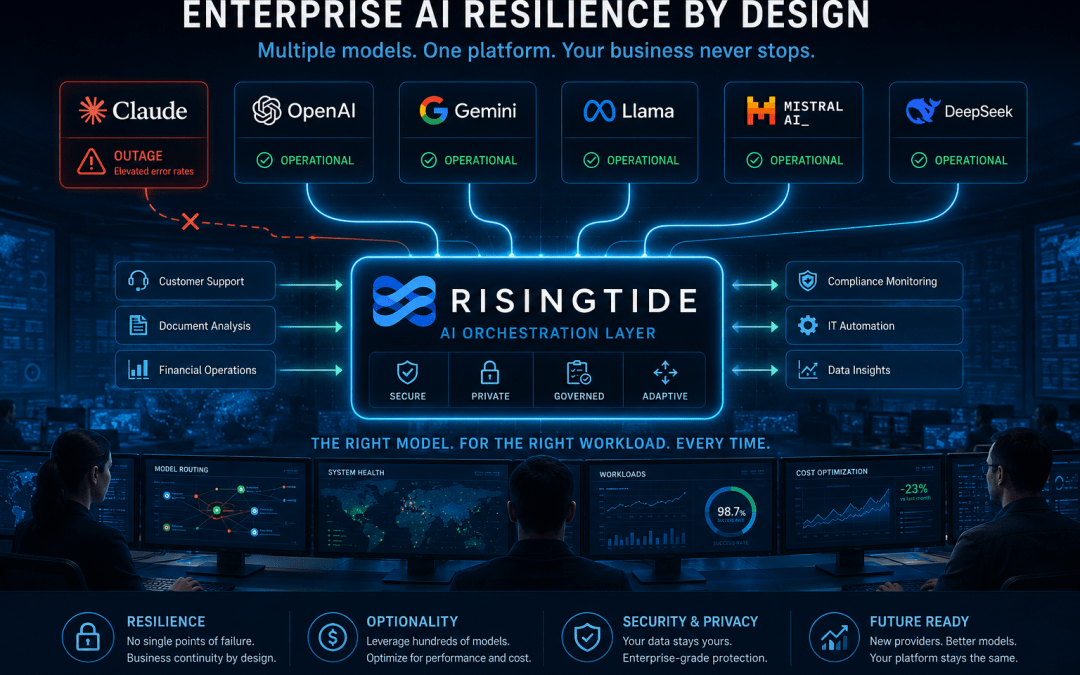
| Open-Weight Model Endorsement | Validates model-agnostic architectures like Rising Tide’s and encourages trust in tenant-specific deployments. |
| Government as a Scalable Customer | If executed, expanded federal adoption creates new platform deployment opportunities inside regulated environments. |
| Workforce Investment in AI Fluency | Builds a deeper talent pool of AI-literate users, analysts, and agents who can extend or adapt RisingTide workflows. |
| Regulatory Sandboxes and Centers of Excellence | Opens up real-world testing zones for enterprise-ready agents and workflows across domains like energy, healthcare, and logistics. |
✅ Compute Accessibility and Costs Could Improve
The plan calls for:
- Strengthening financial and tax incentives for data center development and compute access
- Expanding public-private resource sharing through NAIRR (National AI Research Resource), primarily led by the National Science Foundation (NSF)—designed to democratize access to AI resources for researchers, startups, and educational institutions. Think of it as a public infrastructure backbone for AI R&D
- Reducing long-term exclusivity in cloud access
Why it matters: Rising Tide’s agent-based workflows often rely on flexible, high-performance compute environments. If NAIRR and similar programs remove friction for early-stage deployment and experimentation, this could help startups and platforms like ours compete with incumbents.
✅ A Real Push Toward AI Adoption Across Government
The White House is mandating:
- AI literacy and access across Federal agencies
- Creation of an AI procurement toolbox
- Rapid cross-agency tech transfers
Why it matters: Government is not just a buyer—it’s a model for enterprise adoption. If public sector teams start building and embedding reusable agents to manage internal processes, it opens up new markets for AI platforms like ours to integrate with agency workflows, compliance tools, and data environments.
Think about fuel excise tax calculation and filing, securing permits of every kind, environmental compliance and reporting from the UST’s at our stores to the constructed tanks at terminals and refineries. The list of interactions with local, state and federal government and agencies that we have to work with in our industry is legion any effort to streamline this work with AI enablement on the government side should bring welcome improvements.
✅ Open-Weight Models and Platform Portability
Encouraging:
- Broad adoption of open-source AI
- Domain-specific evaluation frameworks
- Removal of regulatory blockers
Why it matters: NewTide’s RisingTide platform was designed to be model-agnostic and open by design. The push toward open models validates our architecture and may accelerate enterprise trust in customizable, tenant-specific deployments rather than locked-in SaaS AI.
Where the Plan Feels More Like Distraction
For all its ambition, there are signs this Action Plan is more political branding than operator-ready policy. Several elements feel symbolic rather than strategic:
⚠️ Lack of Implementation Detail
While the plan outlines dozens of recommended actions, most are vague (“convene stakeholders,” “issue guidance”) or tied to new councils and studies. While somewhat to be expected at this phase, we’ll have to see how much of this translates into concrete practical advantages for US builders of the technology and for US businesses and consumers looking to benefit from leading the globe in AI.
Why it matters: Builders don’t need more vision statements. We need APIs, funding mechanisms, sandbox environments, and clear procurement pipelines. It’s unclear if or when any of these policies will convert into executable, developer-facing programs. Our industry suffers under tremendous regulation and taxation, practical AI adoption by the agencies we have to work with every day would be a powerful productivity driver.
⚠️ Will it be Rhetoric Over Reality in Infrastructure
The call to “Build, Baby, Build!” is catchy, but is doesn’t solve the regulatory bottlenecks that delay real infrastructure projects. Many of the permitting changes proposed are subject to legal challenge or interagency coordination delays. Again we celebrate the themes outlined in the plan, but we’ll need to see real reform on permitting, especially around power generation and transmission infrastructure to see if this has a significant impact. One encouraging development is the reform the Energy Department has made to make Federal permitting faster that leverages artificial intelligence (AI) and decades of environmental documents to support crucial future analyses. If we could see this kind of pilot work become mainstream it could make a real difference in speed and scalability for the AI industry and developing the energy it requires to run.
Why it matters: If Rising Tide clients want to run AI workloads on hybrid cloud/on-prem systems or co-locate edge agents at the data layer, latency and power constraints matter. Policy won’t solve that unless it moves faster than bureaucracy has for the past few decades. The pace now vs. what we enjoyed in the early 2000’s with internet deployment is substantially slower, if we are going to win globally, we must move with decisive speed.
What AI Users in Our Industry Should Watch For
At NewTide, we’re focused on the practical edge of AI adoption:
Can we empower a company to turn messy processes into intelligent workflows—safely, scalably, and with minimal lift?
From that perspective, here’s what we’re watching:
| Policy Area | If It’s Real | If It’s Theater |
|---|---|---|
| Compute democratization | Easier access to high-end inference for training agents and models | No real change without pricing shifts and contract reform |
| Government adoption acceleration | Expanded enterprise markets for embedded agent use cases and reduced costs associated with our industries regulatory and tax burdens. | Fragmented pilots with no procurement or implementation path for the agencies we depend on and work with daily |
| Workforce AI literacy | Larger, more qualified talent pool for us and our industry overall | Rebranded STEM initiatives with slow impact |
| Open model support | Faster integration of secure, tenant-isolated models into workflows | Political headwinds block trust and industry uptake |
Final Thought: Between the Lines, There’s Real Opportunity
The AI Action Plan may be light on specifics, but buried in the pages are huge signals that matter to platform builders:
- AI is now infrastructure
- AI adoption is now national strategy
- And platform-level tooling—like the agent ecosystem we’re building with Rising Tide—is exactly what this moment demands
While we are excited to see the focus on reducing barriers and improving infrastructure, we’re not waiting for Washington to catch up. We’re shipping daily.