
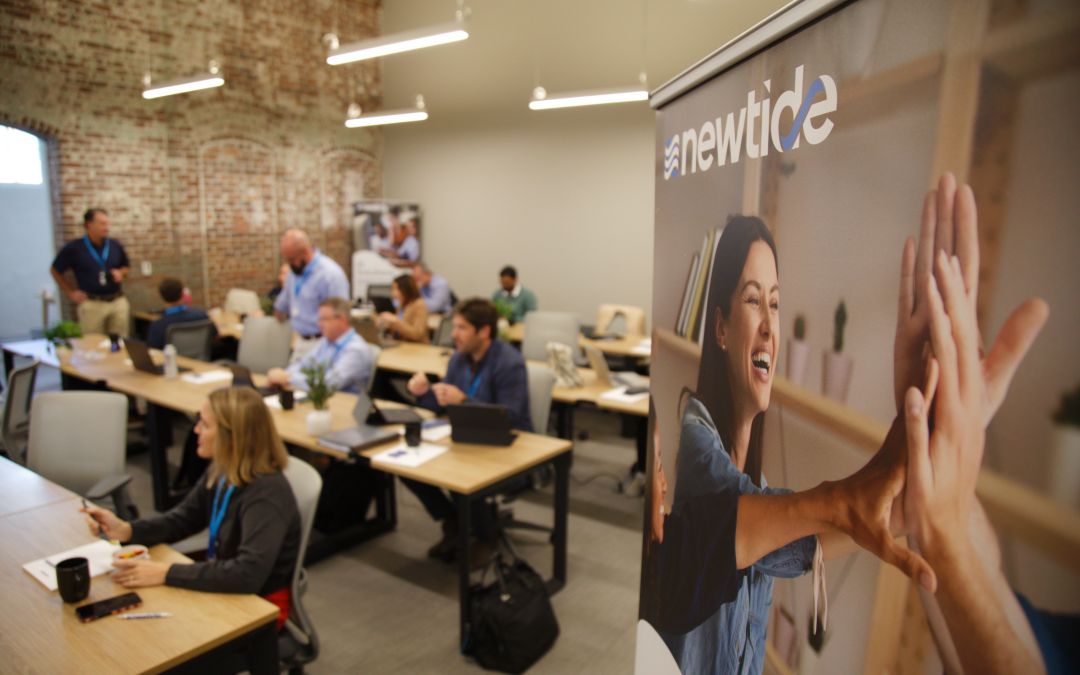
The recent customer summit hosted by NewTide brought together customers, partners, and industry leaders to discuss one of the most important transformations happening across enterprise industries today: the evolution of artificial intelligence from a concept into a practical business tool.
Throughout the event, one message remained consistent across every conversation — AI is not about replacing people. It is about empowering them.
From operational efficiency and automation to data intelligence and workforce transformation, the summit created a space where customers and NewTide leadership could openly discuss the opportunities, challenges, and realities of integrating AI into enterprise environments.
A Shared Vision for Practical AI
For many organizations attending the summit, AI is no longer viewed as a distant technology trend. It is quickly becoming a necessary part of scaling operations, improving productivity, and helping teams focus on more meaningful work.
Kevin French, CEO of Handaband Fuels, spoke about the challenges many growing companies face today.
“How do we double growth while keeping the same staff and costs?”
He explained that many employees spend large portions of their day handling repetitive tasks such as invoicing, processing information, and managing operational workflows. The opportunity with AI, he noted, is to shift people away from routine work and toward problem-solving and innovation.
Kevin also emphasized an important point repeated throughout the summit: organizations already have experienced subject matter experts within their teams. AI should support those employees, not replace them.
“We want employees’ hearts and minds engaged in solving business problems while allowing AI to handle repetitive tasks.”
That human-centered approach to AI adoption was echoed by nearly every speaker at the event.
AI as a Support System, Not a Threat
Nick Peters from Campbell Oil Company shared how their organization is approaching AI implementation carefully and responsibly.
According to Nick, their focus is not on reducing headcount or creating fear around automation. Instead, the company sees AI as a way to improve employee experiences and eliminate time-consuming tasks.
“We are here to support, assist, and help. We genuinely want to help people reach a better point in their work life.”
Nick discussed practical use cases already showing value inside organizations today:
- Helping sales teams better understand products and customers
- Improving communication through AI-assisted writing tools
- Translating highly technical documents into easier-to-understand information
- Navigating complex operational documentation faster and more efficiently
For many businesses, the value of AI starts with these smaller but impactful improvements.
Accelerating Innovation Through Rapid Prototyping
Jim, EVP at Pilot Thomas Logistics, described how AI is dramatically changing the speed at which organizations can prototype and test solutions.
Traditionally, building prototypes and communicating technical concepts across teams could take weeks. With AI tools, that timeline is shrinking to hours.
“AI has shortened the lifecycle from weeks to build a prototype to just hours.”
Jim shared an example from Pilot Thomas Logistics’ retail operations, where the company receives thousands of automated system emails daily from gas pumps and store infrastructure.
Previously, those messages were overwhelming and often ignored. By building a lightweight AI-driven system to organize, summarize, and report the information, the company turned unusable data into actionable operational insights.
The result was a weekly reporting system that development teams now actively rely on to identify and solve recurring issues.
Jim also reinforced a major theme of the summit:
“We will not replace people. We will find better things for those people to do — things that mean more.”
Leading the Next Generation of Enterprise Platforms
For Vlad Collak, CEO and Co-Founder of NewTide, the past year has been nothing short of transformative.
“About a year ago, we were just thinking about how we wanted to build something in this place. Now, within a year, we have a product that is already in production.”
Vlad emphasized that customer collaboration is central to how NewTide continues developing its platform.
“We are here for our customers, and we do not want to sit in our own tower building things in isolation. We want to build solutions that truly matter for their businesses.”
He also outlined the company’s long-term vision: building an enterprise AI platform composed of flexible foundational building blocks that customers can use to create tailored solutions for their own operations.
As the platform matures, NewTide plans to continue expanding its enterprise capabilities, data infrastructure, and customer-facing AI solutions.
“We are building more than just individual AI solutions. We are building a platform — what I like to call ‘Lego blocks’ — where customers can build different kinds of solutions on top of our AI foundation.”
Transforming the Fuel and Convenience Industry
Mukul Vyas, Director of Product and Project Management at NewTide, spoke about the unique opportunity AI presents within the fuel and convenience industry.
With roughly 152,000 gas stations across the United States — many of them independently owned or operating with limited staff — there is significant opportunity for operational automation and intelligent workflow management.
Mukul explained that many organizations already possess large amounts of operational data, but those systems often remain disconnected.
“If we can build an intelligence layer that connects siloed systems and data sources, we can improve productivity, operational efficiency, top-line growth, and bottom-line performance.”
He described the industry’s evolution as a transition from simply accessing information to having systems capable of acting on that information intelligently.
This concept of a “digital workforce” — AI companions that help employees make decisions, automate repetitive tasks, and simplify operations — was one of the most forward-looking ideas discussed during the summit.
Building Relationships Beyond Technology
While much of the summit focused on technology and innovation, another major takeaway was the importance of human connection.
Matej Minaret, Director of Engineering at NewTide, reflected on the value of uniting customers and teams in person.
“The customer summit was amazing because we were able to talk about the things we normally discuss through Teams and emails, but in a much more personal way.”
As organizations continue adopting new technologies at a rapid pace, the summit reinforced that successful transformation depends just as much on collaboration, trust, and communication as it does on software.
Looking Ahead
Across every session, discussion, and customer interview, one idea became clear: enterprise AI is moving from experimentation into real-world operational impact.
Businesses are no longer asking whether AI matters. They are asking how to implement it responsibly, strategically, and in ways that genuinely support employees and customers.
The Newtide Customer Summit highlighted a future where AI is not simply another tool, but an intelligent operational layer that helps organizations scale faster, solve problems more effectively, and create more meaningful work for people.
And according to both customers and leadership, this transformation is only beginning.
As Vlad Collak said:
“We’re just getting started.”